
The Benefits of Backdating a Porsche 911 vs a Standard Restoration
The Benefits of Backdating a Porsche 911 vs a Standard Restoration
If you're weighing up a backdate against a factory-correct restoration, the two builds are aimed at genuinely different people. Neither is the "better" choice on its own. It depends on whether you want a museum piece or a car you'll actually drive every week.
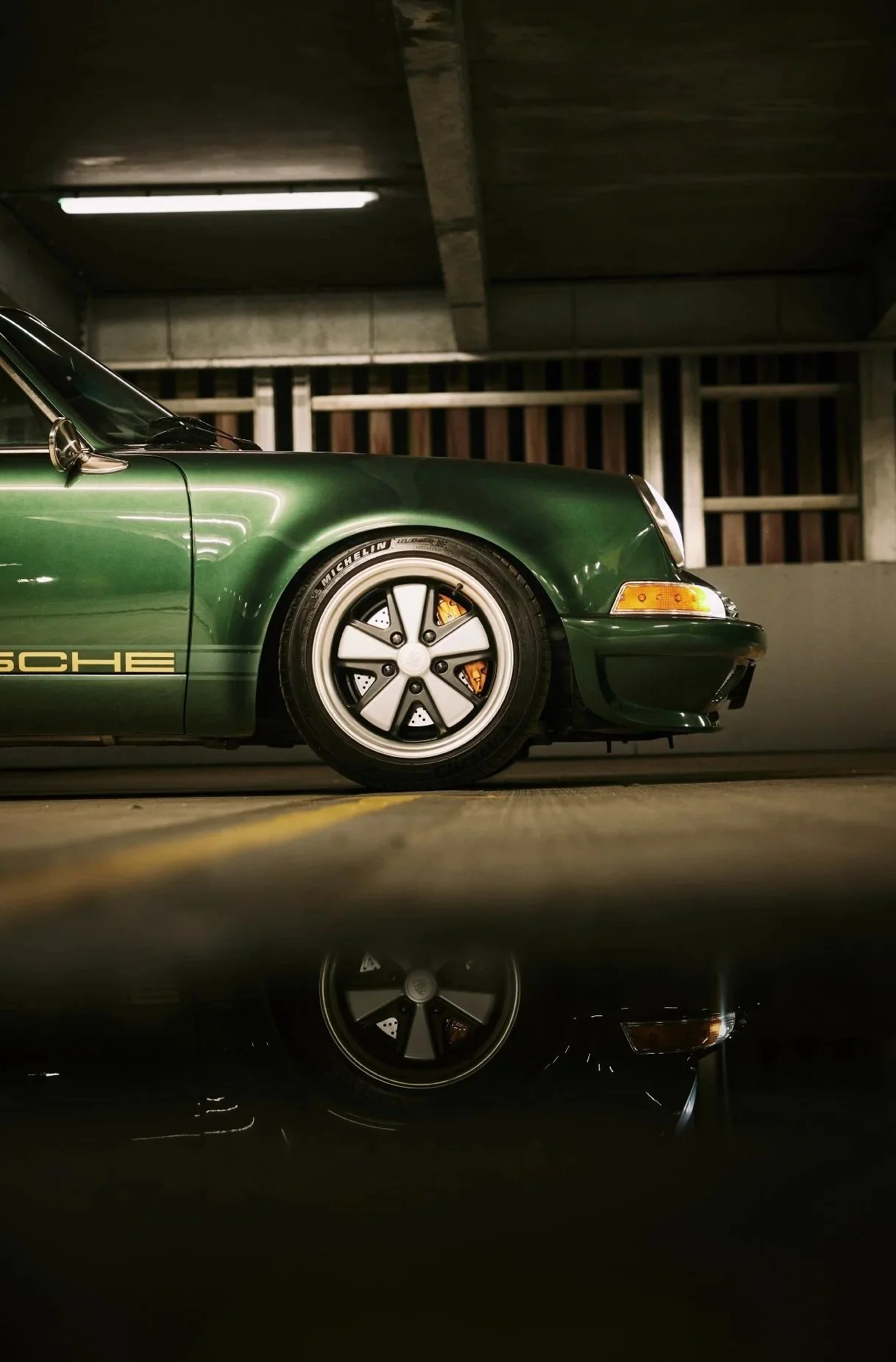
What backdating actually is
Backdating means taking a later, more advanced donor 911, most commonly a 964 (1989–1994) or an earlier G-Body (1974–1989), and reworking the bodywork to resemble the slim-bumpered, long-hood look of the pre-1974 classic 911s. The styling moves backward. The engineering underneath stays modern.
A standard restoration is different in both goal and process: the car is stripped, repaired, and rebuilt to match its original factory specification as closely as possible, down to paint codes, trim, and mechanical components. Nothing moves backward or forward in style — the goal is to return the car to exactly what it was.
Backdate vs Restoration at a Glance
| Backdate | Standard Restoration | |
|---|---|---|
| Goal | Classic look, modern engineering | Return to original factory spec |
| Typical donor | 964 or 993 (newer, more capable chassis) | The original car itself |
| Drivability | Power steering, ABS, fuel injection, A/C | Whatever the car originally had |
| Personalization | Fully bespoke, your spec | Period-correct only |
| Value driver | Build quality and specification | Numbers-matching authenticity |
| Best for | Regular driving, daily or weekend use | Collecting, concours, long-term hold |
| Typical timeline | 8–12 months at Shoreline 911 | Varies widely by scope and originality |
Why people choose a backdate over a standard restoration
Modern drivability. A standard restoration of a genuine 1960s car keeps you locked into 1960s engineering: no power steering, no ABS, carburetors instead of fuel injection, and none of the creature comforts you'd expect from any modern car. A backdate starts from a newer chassis, so you keep things like air conditioning, power steering, ABS, and fuel injection, paired with a significantly more powerful engine. Most Shoreline 911 builds run a 3.6L or 3.8L flat-six, with output ranging from around 300 BHP up to 400+ BHP depending on the tier.
The look without the fragility or the price tag. Genuine early long-hood 911s are rare, mechanically delicate by modern standards, and increasingly expensive to acquire in good condition. A backdate gives you that same iconic silhouette without either problem. You're not risking a numbers-matching collector car on daily use, and you're not paying collector-car prices to get the look.
Full personalization. A factory-correct restoration is about matching the original as closely as possible: correct paint codes, original trim, period-correct everything. A backdate, or restomod, goes the other way. You can mix period-correct styling cues with modern materials, carbon fiber panels, LED lighting, and a fully bespoke interior built to your own spec rather than the factory's.
Where a standard restoration still makes more sense
If historical accuracy and matching-numbers authenticity matter to you, a standard restoration is the right call. It preserves the car's original character and its investment-grade value as a genuine period piece. That's a real and valid goal, particularly for a car you're planning to hold long-term as a collectible rather than drive hard.
Frequently Asked Questions
Does backdating hurt a car's resale value? A backdate is valued differently than an original, numbers-matching car — it's judged on build quality, specification, and documentation rather than factory originality. A well-documented, professionally built backdate holds its value within that market; it's simply not competing in the same category as a concours-original restoration.
Can a backdate be reversed back to original spec? In principle, most exterior changes can be reversed, but in practice almost nobody does. The donor car's original panels are typically retired during the process, so a true reversal would mean sourcing period-correct replacement panels rather than simply undoing the work.
How long does each option take? A Shoreline 911 backdate typically takes 8 to 12 months from confirmed donor to delivery. A standard restoration's timeline depends heavily on the car's original condition and how much needs sourcing versus repairing, and can vary far more widely.
Do I need to already own a donor car? No. Shoreline 911 can source and vet a suitable 964 or 993 donor through its own network if you don't already have one, or inspect a car you already own against build standards.
The honest trade-off
Backdating is built for a different owner: someone who wants a car with the classic silhouette but wants to actually use it, whether that's a daily commute, a weekend blast, or the occasional track day, without babying a 50-year-old drivetrain. A standard restoration is built for preservation. Backdating is built for use.
At Shoreline 911, every backdate starts from a bare 964 or 993 shell and is rebuilt to order, so you're choosing the platform, the engine tier, the configuration (Carrera 2 or Carrera 4), and every detail of the interior yourself. If you're trying to decide which platform fits your build, our 964 vs 993 comparison breaks down the differences in proportions, suspension, and engine options, and our backdate cost breakdown covers realistic pricing.
Start a conversation about your build or browse current Shoreline 911 builds.
Your air-cooled 911, built around you.
Every Shoreline car is a hand-built Porsche 911 restomod, engineered from a hand-picked 964 or 993 donor and specified entirely by you. Build slots are limited each year.